
Manufacturing ERP Software in Bangladesh for Complete Factory & Production Control
Manufacturing becomes difficult to control when production planning, raw materials, inventory, purchase, costing, accounts and finished goods are managed in separate systems.
A production manager may know what needs to be manufactured, but the store team may not know the exact material requirement. Accounts may know how much was purchased but not the actual cost of each finished unit. Management may see total sales without knowing which production batch generated the expected margin.
MM IT SOFT LTD develops Manufacturing ERP Software in Bangladesh that connects these operations through one centralized system.
Our manufacturing ERP can be configured around your actual factory workflow, from raw material purchasing and Bill of Materials (BOM) to production orders, work-in-progress, costing, quality control, finished goods and management reporting. Instead of forcing your factory into a fixed software process, the ERP structure can be planned around the departments, production stages, approval rules, reports and operational controls your business actually needs.
Evaluate ERP for Your Factory
Request a customized manufacturing ERP scope & live software demo with MM IT SOFT LTD.
Request Demo & ScopeUnlike basic accounting or inventory software, a manufacturing ERP has to understand how materials are transformed into finished products. Each transaction can affect another part of the business.
When raw materials are issued to production, inventory changes. When production is completed, finished-goods stock changes. Material, labour and other applicable costs can contribute to production costing. Management can then review production, stock and financial information from connected records rather than collecting separate spreadsheets from different departments. That is the key purpose of an ERP system for manufacturing: connecting the complete manufacturing workflow.
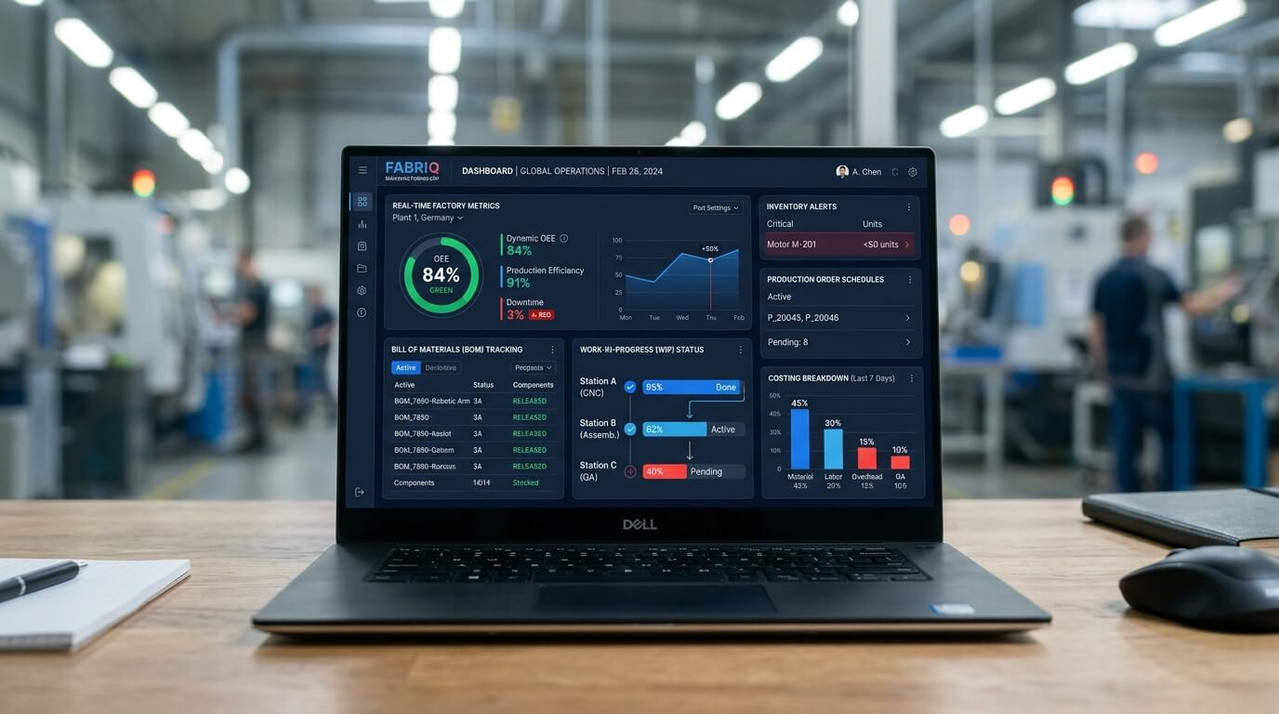
Real-Time Factory Dashboard & Operations Control
Turn complex factory data into clear management visibility. Monitor production lines, BOM calculations, WIP stages, inventory alerts, and costing breakdowns from one connected interface.
Centralized Management Intelligence for Factory Directors
A manufacturing ERP should not only record raw transactions. It turns operational floor data into actionable insights so management can stop collecting disconnected spreadsheets and make faster operational decisions.
- Planned vs Actual Output: Real-time production order monitoring.
- Dynamic BOM Costing: Automatic raw material, labor & overhead allocation.
- WIP Stage Tracking: Visibility into active floor batches and bottlenecks.
- Low Stock & Reorder Alerts: Automated MRP procurement triggers.
Why Manufacturing Companies in Bangladesh Need ERP Software
A growing factory creates thousands of operational records. Purchase orders are created. Materials arrive. Stock moves between stores. Production orders are issued. Materials are consumed. Employees and machines perform activities. Waste occurs. Products are dispatched. Managing all of this manually becomes increasingly difficult as production volume grows.
Stock Mismatch
Raw material stock not matching physical stock due to unrecorded issues, unlogged scrap, or store errors.
Production Delays
Production delays caused by poor material planning and late emergency procurement.
WIP Tracking Difficulty
Difficulty tracking work-in-progress as batches move through multiple floor stages.
Unreferenced Material Issue
Material issued to the floor without proper production order reference or control.
Unclear Cost Per Unit
Unclear production cost per unit combining raw material, labor, overheads, and wastage.
Excessive Wastage
Excessive material wastage going unmonitored due to lack of standard BOM comparisons.
Manual BOM Calculations
Time-consuming manual BOM calculations prone to spreadsheet errors.
Weak Department Coordination
Weak coordination between purchase, store, production, sales, and accounts teams.
Stock Discrepancies
Finished-goods stock discrepancies between store counts and sales dispatch ledgers.
Manual Production Reports
Production reports prepared manually, leading to human errors and lost time.
Delayed Management Info
Delayed management information preventing timely decision-making on the floor.
Isolated Department Data
Different departments maintaining separate data in disconnected spreadsheets.
Limited Factory Visibility
Limited visibility into actual daily factory performance and operational profitability.
Manufacturing ERP Modules We Can Build Around Your Factory Workflow
Different factories have different production processes. A textile manufacturer may not operate like a furniture factory. MM IT SOFT LTD develops custom manufacturing ERP software based on approved requirements rather than assuming every manufacturer needs exactly the same configuration.
Production Planning & Scheduling
Determines what needs to be produced, how much, when to start, materials required, production stages involved, and completion dates.
- Defined order-driven production plans
- Planned vs actual quantity tracking
- Resource & capacity scheduling
Bill of Materials (BOM) Management
Defines the materials, components, and quantities required to manufacture a product. Provides a reusable production structure.
- Multi-level & multi-variant BOMs
- Standard consumption & recipe structures
- Material variance & wastage control
Material Requirements Planning (MRP)
Determines what materials are required, how much is needed and when they should be available for planned production quantities.
- Production & BOM requirement matching
- Available stock vs shortage calculation
- Automated procurement requisitions
Raw Material Inventory Management
Connects raw material inventory with purchase and production activities so businesses can monitor material movement clearly using our inventory management software.
- Goods received & supplier ledgers
- Material issue, returns & transfers
- Reorder point alerts & stock reports
Production Order Management
Provides a controlled record of what the factory intends to produce, including product, quantity, BOM, and status.
- Batch & lot traceability
- Responsible department mapping
- Status & completed quantity logs
Work Order Management
Provides a structured workflow for individual production activities across multiple floor operations instead of verbal instructions.
- Specific task & batch assignment
- Planned start & completion schedules
- Responsible operator accountability
Work-in-Progress (WIP) Tracking
Gives management clear visibility into products passing through production stages before final completion.
- Stage-wise quantity in process
- Materials consumed & pending quantity
- Production bottleneck detection
Shop Floor & Production Tracking
Connects management planning with actual operational floor execution, recording material issued, quantity produced, and scrap.
- Production started & stage complete logs
- Quantity produced vs rejected
- Floor transfers to next stage
Production Costing
Answers how much it actually costs to manufacture one unit by organizing raw materials, direct labour, expenses, and overheads.
- Raw materials & component cost
- Labour & overhead allocation
- Product-level margin analysis
Material Consumption & Wastage Management
Provides structured records comparing standard BOM requirements against actual issued and consumed material quantities.
- Planned requirement vs actual issue
- Recorded wastage & scrap variance
- Material returned to store records
Finished Goods Inventory Management
Connects completed production with finished goods inventory to maintain clear records between factory and sales.
- Produced quantity & available stock
- Warehouse locations & stock movement
- Sales, dispatch & customer returns
Quality Control (QC) Management
Records relevant quality inspection data during or after production, linking results directly with production history.
- Inspection stage & quantity checked
- Accepted vs rejected quantities
- Rejection reasons & quality approvals
Procurement & Supplier Management
Connects production requirements with purchase requisitions, supplier records, goods receipts, and supplier payables.
- Purchase requisitions & purchase orders
- Supplier records & purchase history
- Goods received & supplier ledgers
Warehouse Management
Connects separate stock locations (raw materials, WIP, finished goods, spares) and records transfers between stores.
- Raw materials & packaging stores
- Multi-warehouse inventory control
- Store-to-store stock transfers
Machine & Labour Tracking
Incorporates information related to machine allocation, production lines, labor assignments, work hours, and output quantity.
- Machine allocation & line mapping
- Labour assignment & work hours
- Stage-wise output tracking
Manufacturing Accounting & Financial Integration
Connects manufacturing activity with financial modules so expenses, purchases, sales, and ledgers update seamlessly.
- Purchase & supplier payables
- Sales & customer receivables
- Ledger, P&L & Balance Sheet
Sales, Delivery & Finished Product Flow
Connects customer demand from CRM Software in Bangladesh with production planning and finished goods dispatch to support customer fulfillment.
- Sales Plan → Production Planning
- Finished Goods → Delivery Challan
- Invoicing & Accounts Integration
Production Reports & Management Dashboard
Turns operational floor data into actionable management dashboards and reports covering stock, costing, and performance.
- Planned vs actual production metrics
- Raw material & finished stock ledgers
- Production costing & wastage reports
One Connected Manufacturing Workflow
A properly designed manufacturing ERP connects departments instead of creating another isolated system. Here is the seamless workflow MM IT SOFT LTD builds:
Benefits of ERP Software for Manufacturing Companies
Discover how a centralized manufacturing system delivers operational control across your factory.
Better Production Visibility
Management can review production activity using structured records rather than waiting for several manually prepared reports.
More Accurate Material Planning
BOM and MRP-related workflows help teams understand material requirements before production begins.
Improved Inventory Control
Raw materials, WIP and finished goods can be managed as connected parts of the manufacturing process.
Better Cost Visibility
Structured production-cost records make it easier to understand where manufacturing costs originate.
Reduced Duplicate Data Entry
Connected departments can reduce repeated entry of the same business information across unrelated applications.
Stronger Traceability
Production orders, material issues, work orders, WIP and finished goods can be connected through a structured history.
Better Department Coordination
Purchase, store, production, sales and accounts can work with related information rather than maintaining isolated records.
Faster Management Reporting
ERP data can be converted into production and business reports without rebuilding everything manually in spreadsheets.
Manufacturing ERP for Small, Medium & Growing Factories
Manufacturing ERP is not only relevant to very large factories. The important question is: Has your production process become too complex to control efficiently using spreadsheets, manual registers or disconnected software?
Smaller & Medium Factories
A smaller manufacturer can initially start with core essential modules without unnecessary enterprise overhead:
- Bill of Materials (BOM) Management
- Raw Material Inventory & Purchases
- Production Orders & Material Issue
- Finished Goods & Basic Sales
- Essential Financial Accounting
Large & Growing Enterprise Factories
A larger enterprise factory can deploy expanded advanced modules across multi-location operations:
- Multiple Warehouses & Multi-Factory Control
- Multiple Production Stages & Complex BOMs
- Advanced Department Workflows & Approvals
- Detailed Costing, Integrations & Role Permissions
- Real-time Executive Management Dashboards
Industries That Can Use Manufacturing ERP Software
Manufacturing ERP can be configured for different production models in Bangladesh:
Textile & Garments
Manage materials, production processes, inventory, costing and finished goods according to specific garment workflows.
Food & Beverage
Structure material consumption, recipes/BOM, batch-oriented production, inventory and costing according to requirements.
Plastic Manufacturing
Track raw materials, production quantities, consumption, wastage and finished goods across molding lines.
Furniture Manufacturing
Connect materials, components, production jobs, costing and finished-product inventory.
Engineering & Metal
Manage components, BOM, production orders, work stages and cost information for fabrication.
Packaging Manufacturing
Track paper/sheet materials, production quantities, scrap wastage and finished stock.
Electronics Components
Manage multi-component BOM, material requirements, assembly stages and finished products.
Pharmaceuticals
Planned around appropriate production and quality workflows where precise regulatory requirements are defined.
Cloud Manufacturing ERP vs On-Premise ERP
Both deployment models can be appropriate depending on your operational environment, IT policies, connectivity and budget.
Cloud ERP
Provides easier access from authorized locations and simplifies centralized deployment across distributed operations.
- Ideal for multi-location factories & remote access
- Distributed users & centralized management
- Lower initial server hardware investment
- Managed backups & cloud security
On-Premise ERP
Considered where the organization has specific internal infrastructure, local network, security or internal deployment requirements.
- Internal server network deployment
- Complete local control & security policy compliance
- High performance on local LAN networks
- Configured to company IT environment
Manufacturing ERP Software Price in Bangladesh
There is no responsible single price for every manufacturing ERP project because manufacturing complexity varies significantly. MM IT SOFT LTD currently lists enterprise, manufacturing and garments ERP implementations starting from BDT 100,000.
Starting Project Scope
Starting from BDT 100,000
Final quotation is prepared after thorough requirement analysis based on your factory scope.
Discuss Pricing on WhatsApp (+8801860424344)The final manufacturing ERP software cost depends on:
Custom Manufacturing ERP vs Ready-Made Software
A ready-made ERP can work when your processes closely match the product's predefined workflow. Custom ERP becomes more relevant when your factory has distinctive operational needs.
| Factory Requirement | Custom Manufacturing ERP (MM IT SOFT LTD) | Ready-Made Manufacturing Software |
|---|---|---|
| Production Stages | Designed around your approved production stages and workflow | Fixed predefined workflow steps |
| BOM Structures | Configured for your exact components, variants, and recipes | Generic standard material lists |
| Costing Rules | Matches your accounting rules, overhead allocation, and scrap formulas | Static predefined cost calculation formulas |
| Approval Processes | Custom hierarchy for POs, material issues, and quality checks | Fixed approval permissions |
| Reporting & Integration | Tailored management dashboards, user permissions, and custom APIs | Standard pre-built reports with restricted customization |
How Our Manufacturing ERP Development Process Works
Our systematic implementation journey from initial discovery to long-term support.
Requirement Discussion
We start by understanding your manufacturing business, products, departments and operational problems.
Current Workflow Analysis
The existing process is reviewed, including how purchasing, materials, production, inventory, accounts and reporting currently work.
Module & Workflow Planning
Required ERP modules, users, permissions, workflows, reports and integrations are defined.
Demo / Solution Discussion
Where appropriate, relevant software functionality can be demonstrated and project requirements discussed.
Scope & Commercial Proposal
Once requirements are understood, project scope, implementation considerations and pricing are prepared.
Development & Configuration
The agreed manufacturing ERP functionality is developed or configured around the approved scope.
Testing
Relevant production workflows, inventory ledgers, and accounts are tested before final deployment.
Deployment & Training
The system is deployed according to the agreed plan, and relevant users are trained on approved workflows.
Support & Further Improvement
Further support or approved enhancements are planned according to evolving business needs.
ERP vs MRP: What Is the Difference?
MRP primarily focuses on material and production requirements, while ERP connects manufacturing with broader business operations.
| Dimension | MRP (Material Requirements Planning) | Manufacturing ERP System |
|---|---|---|
| Core Focus | What materials are required? How much is needed? When is it needed? What production creates demand? | Broader business environment connecting manufacturing with all company operations. |
| Scope & Integration | Production and material planning only. | Inventory, Procurement, Sales, Accounting, HR, Warehouse, Management Reporting, and MRP. |
How to Choose Manufacturing ERP Software in Bangladesh
Do not choose ERP only by counting features. Evaluate whether the system can represent the way your factory actually operates. Before making a decision, ask these 9 questions:
1. Can the ERP handle our production workflow?
Show the vendor a real production example from your floor.
2. Can it manage our BOM structure?
Critical for component or material-intensive production.
3. Can it connect raw material inventory with production?
Inventory should not remain isolated from manufacturing.
4. Can we monitor work-in-progress?
Essential if products pass through several floor stages.
5. Can it calculate the cost information we require?
Clarify how your factory calculates material, labour, and overhead costs.
6. Can the system manage our warehouses?
Important for factories with separate raw-material and finished-goods stores.
7. Can it grow with our company?
Consider future factories, warehouses, users, products and reporting requirements.
8. Can it integrate with accounts?
Production decisions eventually affect financial results.
9. Who will implement and support the system?
ERP success depends on implementation understanding as much as software features.
Why Consider MM IT SOFT LTD for Manufacturing ERP Development?
MM IT SOFT LTD is a custom ERP software development company based in Dhaka, Bangladesh.
Our approach begins with the business workflow. For manufacturing projects, that means understanding relationships between areas such as:
Purchase → Raw Materials → BOM → Production → WIP → Finished Goods → Sales → Accounts
before deciding the final software structure. Depending on approved requirements, manufacturing ERP can also connect with wider business modules including Inventory Management Software, Sales & CRM Software, HR & Payroll, Warehouse Management, and Management Reporting. Explore our client portfolio & case studies across Bangladesh.
Wider Integrated ERP Capabilities:
Frequently Asked Questions About Manufacturing ERP Software
Clear answers to questions asked by factory owners and production managers in Bangladesh.
Discuss Your Manufacturing ERP Requirements
If spreadsheets, manual registers and disconnected applications are making it difficult to control production, inventory or manufacturing costs, the first step is to map your current workflow.
MM IT SOFT LTD can review your manufacturing process, products, BOM, raw materials, production stages, warehouses, users, accounting requirements, reports, existing software, and required integrations to define an appropriate custom ERP project scope.
Haque Mansion, 5th Floor, 21/1 Zigatola, Dhanmondi, Dhaka-1209, Bangladesh
Request ERP Consultation / Demo
Discuss your factory workflow with MM IT SOFT LTD and request a project scope and quotation.