
Hospital Management Software in Bangladesh Built Around Your Hospital Workflow
A hospital does not operate through one counter or one department. A patient may register at reception, book a doctor appointment, complete an OPD consultation, take laboratory tests, purchase medicines, make payments and later require admission, a bed, procedures, nursing care or follow-up treatment.
Behind that patient journey, hospital staff must also manage inventory, purchases, suppliers, employee access, payroll, accounts and management reporting.
MM IT SOFT LTD provides Hospital Management Software in Bangladesh designed to connect clinical, operational, administrative and financial hospital workflows in one structured system.
We do not start by assuming that every hospital should use exactly the same software structure. The process starts with your actual hospital workflow: how patients register, how doctors consult, how admissions work, how charges are created, how pharmacy and laboratory services connect with patients, how departments use information and what reports management needs. The final Hospital Management System can then be configured around the approved requirements.
1. What Is Hospital Management Software?
Hospital Management Software is a digital system used to manage and connect important activities across a hospital or healthcare organisation.
Depending on the selected modules, the system can manage:

The main purpose is not simply to convert paper forms into digital forms.
A useful hospital system should reduce unnecessary duplicate entry and create clearer relationships between the patient, services, departments, billing and management information.
For example, across a connected patient journey:
For hospitals that require several departments and back-office functions to work together, the system can operate as a Hospital ERP Software rather than a standalone billing application.
Learn more about Custom ERP Software Development.
2. Why Hospitals Need a Connected Management System
A hospital can use several software applications and still have fragmented information across departments.
For example:
- Reception may maintain patient registration.
- Doctors may use another process for clinical notes.
- The laboratory may prepare its own reports.
- The pharmacy may maintain a separate stock system.
- Billing may depend on information sent manually by several departments.
- Accounts may again record financial information separately.
Eliminating Operational Gaps
This creates operational gaps.
A connected Hospital Management System in Bangladesh can organize these activities around shared patient and transaction information so authorised departments do not have to recreate the same data unnecessarily.
3. Problems a Hospital Management System Can Help Organize
When hospital operations rely on manual entries or disconnected applications, administrative friction and financial leakage inevitably arise:
1. Repeated Patient Information
When patient information exists in several registers or systems, staff may create duplicate patient profiles or repeat the same registration work.
2. Slow Patient Registration
Long registration processes increase pressure on reception and create queues before the patient has even reached the doctor.
3. OPD and IPD Records Are Disconnected
A patient's outpatient history may be separate from admission information.
4. Billing Depends on Manual Department Updates
Hospital billing may include:
- Registration
- Consultation
- Bed charges
- Laboratory
- Procedures
- Operation Theatre
- Pharmacy
- Additional services
- Discounts
- Advance
- Due
- Refund
If each department sends charges manually, billing becomes slower and increases the chance of missing information.
5. Bed Availability Is Difficult to Track
Admission staff need to know:
- which beds are available
- which are occupied
- which ward a patient is in
- whether a patient has been transferred
- whether a bed has become available after discharge
6. Pharmacy Stock Does Not Match
Hospital pharmacies deal with medicine purchases, suppliers, stock, batches, expiry and issue or sales.
7. Laboratory Information Takes Too Long to Reach Other Departments
Laboratory workflows can involve test requests, samples, processing, result entry and report preparation.
8. Doctors and Staff Cannot Find Historical Clinical Information
When clinical notes exist only in paper folders, reviewing past consultations, tests, prescriptions or admissions takes time and increases reliance on physical files.
9. Dues, Advances and Adjustments Become Difficult to Settle
When patients make partial payments, pay in advance, receive corporate or authorized discounts, or settle bills at discharge, manual tracking can lead to disputes or delayed reconciliation.
10. Hospital Management Lacks Timely Operational Visibility
Management cannot easily review daily collections, department revenues, doctor appointments, bed occupancy, pharmacy sales, due balances or hospital expenses when every department reports separately.
4. What Does Hospital Management Software Do?
A comprehensive Hospital Management System digitizes and connects clinical, administrative, diagnostic, and financial touchpoints across the healthcare facility:
Patient Identification
Maintains patient profiles, contact details, emergency information and hospital ID / registration numbers.
Appointment Management
Organizes doctor schedules, visiting hours, appointment slots and visit queues.
Outpatient Department (OPD)
Handles OPD registration, doctor assignment, consultations, service billing and investigations.
Inpatient Department (IPD)
Manages admissions, bed/cabin allocation, transfers, inpatient doctor visits, nursing notes, clinical procedures and discharge clearance.
Electronic Medical Record (EMR)
Keeps clinical histories, diagnoses, previous visits, prescriptions, vitals and laboratory results in one organized profile.
Hospital Billing
Consolidates consultation, diagnostic, bed, surgical, medication and auxiliary charges into structured invoices with support for advances, discounts and discharge settlements.
Diagnostic & Pathology Management
Manages test requests, specimen tracking, result entry, lab doctor authorization and patient test report delivery.
Hospital Pharmacy
Tracks drug purchases, vendor supplies, batch numbers, expiry dates, counter sales and IPD medicine issues.
Inventory & Procurement
Manages hospital consumables, surgical instruments, linen, cleaning supplies, purchase orders, requisitions and supplier balances.
Operation Theatre (OT) Management
Coordinates OT schedules, surgeon bookings, surgical teams, anesthesia notes, procedure logs and post-operative ward transfers.
Hospital Accounting
Bridges operational billing with general ledgers, journal vouchers, daily collections, expense tracking, accounts receivable/payable and balance sheets.
HR & Payroll
Tracks healthcare staff attendance, duty rosters, shift schedules, doctor commissions, employee loans, deductions and monthly salary disbursements.
User Access Governance
Enforces strict role-based access permissions ensuring doctors, nurses, cashiers, pharmacists and administrators access only authorised data.
Multi-Branch / Clinic Network
Connects central hospital operations with satellite diagnostic clinics, sample collection points and remote branch centers.

5. Core Modules in MM IT SOFT LTD Hospital Management Software
MM IT SOFT LTD provides modular, scalable, and configurable healthcare enterprise modules built specifically for hospitals, polyclinics, and diagnostic centers:
Patient Registration & Appointment Management
Provides fast digital registration for new and returning patients with unique hospital IDs (UHID), doctor schedule calendars, appointment booking, queue management tokens, and visit history lookups.
- Unique Hospital ID (UHID)
- Doctor Visiting Calendars
- Token Queue Management
- Emergency Contact Records
- SMS Appointment Alerts
Outpatient Department (OPD) Management
Manages OPD consultations, vital signs logging, doctor assignment, diagnostic test ordering, electronic prescriptions, OPD service billing, and scheduled follow-up visits.
- OPD Doctor Chambers
- Patient Vital Signs Entry
- One-Click Investigation Order
- Digital Prescription Generation
- Follow-up Tracking

Inpatient Department (IPD) & Admission Management
Handles patient admission processing, bed and cabin allocation, attending doctor rounds, daily medication orders, clinical notes, nursing care charts, procedure logs, and discharge planning.
- Admission Orders & Consent
- Daily Doctor Rounds & Notes
- Nurse Station Care Plans
- Medication Administration Records
- Discharge Clearance Workflow
Bed, Ward & Cabin Management
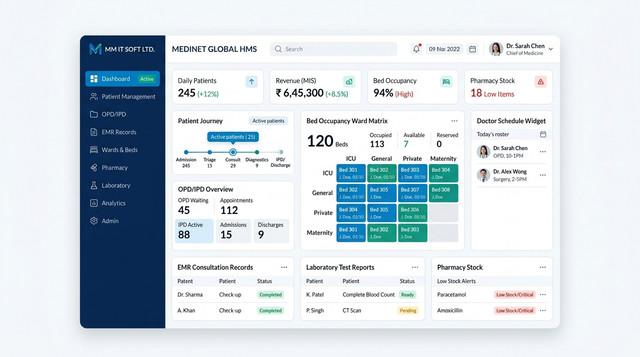
Visual real-time floor map showing bed occupancy status (occupied, vacant, cleaning, maintenance, reserved), ward categorization (ICU, CCU, General Ward, Deluxe Cabin), and bed transfer histories.
- Interactive Floor Status Map
- ICU, CCU, Cabin & Ward Tracking
- Automated Daily Bed Rent Billing
- Inter-Ward Bed Transfers
- Housekeeping Clearance

Electronic Medical Records (EMR) & Clinical History
Secure, centralized digital medical record maintaining past diagnoses, clinical observations, allergy alerts, past surgical histories, investigation reports, and lifetime treatment timelines.
- Longitudinal Patient History
- Customizable Doctor Examination Templates
- Allergy & Chronic Condition Warnings
- Digital Diagnostic Report Vault
- ICD-10 Disease Categorization
Diagnostic & Laboratory Management
Automated diagnostic workflow from test billing and sample collection barcodes to lab machine interfacing, result entry, pathologist verification, and instant digital PDF report printing.
- Automated Sample Barcode Printing
- Lab Analyzer Interfacing (LIS)
- Reference Range Normal/Abnormal Highlighting
- Pathologist Digital Signatures
- Online Patient Report Download Portal
Hospital Pharmacy & Inventory Management
Complete pharmaceutical management connecting OTC sales, IPD medicine requisitions, vendor purchases, batch-wise stock, expiry date tracking, reorder alerts, and supplier ledgers.
- IPD Ward Requisition & Issue
- Barcode POS Medicine Dispensing
- Batch Number & Expiry Date Management
- Automated Low-Stock Reorder Warnings
- Supplier Purchase & Payment Ledgers
Operation Theatre (OT) Management
Schedules surgical suites, assigns surgical teams (lead surgeons, assistants, anesthesiologists, OT nurses), logs pre/post-operative notes, and calculates OT service charges.
- OT Calendar & Room Booking
- Surgeon & Anesthesia Notes
- Surgical Consumables Tracking
- OT Charge Categorization
- Recovery Ward Handoff Logs

Hospital Billing, Dues & Settlement
Consolidates all inpatient and outpatient charges into unified itemized invoices, managing advance payments, corporate/insurance tie-ups, doctor referral fees, due recovery, and discharge settlements.
- Itemized Consolidated Invoicing
- Advance Deposit & Due Tracking
- Corporate / TPA Insurance Billing
- Doctor Referral Fee Auditing
- Discharge Clearance Settlement
Hospital Accounting & Financials
Direct integration between billing cashiers and general ledger accounting, providing shift-wise cash reconciliations, expense vouchers, accounts payable, accounts receivable, and balance sheets.
- Daily Cashier Collection Reconciliation
- Automated Journal Vouchers
- Supplier Accounts Payable
- Expense Vouchers & Cost Centers
- Real-Time Income Statement & Balance Sheet
Hospital HR, Duty Roster & Payroll
Maintains medical staff directories, shift duty rosters for nurses and resident doctors, biometric attendance integration, doctor commission calculations, and monthly salary disbursements.
- Doctor & Nurse Shift Duty Rosters
- Biometric Attendance Machine Integration
- Doctor Consultation Honorarium Calculation
- Salary Slips with Allowances & Deductions
- Staff Leave & Loan Management
Multi-Branch & Diagnostic Network Control
Centralized cloud management connecting multiple hospital branches, satellite sample collection booths, and regional diagnostic units with unified patient IDs and central financial auditing.
- Unified Patient Record Across Branches
- Inter-Branch Sample & Test Routing
- Centralized Medicine Procurement
- Branch-Wise Comparative Revenue Reports
- Head Office Real-Time Executive Dashboard
6. Why Healthcare Workflows Need Customization
No two hospitals in Bangladesh operate identically. Healthcare facilities vary greatly in clinical specializations, patient turnover, and administrative governance:
General Hospitals (50–500+ Beds)
Requires extensive Inpatient Department (IPD) workflows, multi-tier nurse stations, Operation Theatre management, intensive care units (ICU/CCU), and multi-department supply requisitions.
Specialized Diagnostic Centers
Demands rapid sample collection token queues, automated barcode generation, multi-analyzer laboratory machine interfacing, and fast digital report delivery via SMS or online portal.
Specialized Clinics (Eye, Dental, Maternity)
Requires specialized examination templates, custom doctor consultation forms, specialized clinical diagrams, and procedure-specific billing workflows.
Corporate & Insurance Hospitals
Requires customized credit agreements, pre-authorization workflows, discounted pricing schedules, and detailed claim submission ledgers.
Customized Architecture Around Your SOPs
MM IT SOFT LTD customizes the system architecture around your approved hospital standard operating procedures (SOPs), ensuring your staff adopt the platform effortlessly without altering their proven clinical practices.
7. Role-Based User Permissions in Hospital Software
Protecting patient confidentiality and preventing revenue leakage requires granular, role-based access control across every department:
Doctors & Consultants
Access patient clinical history, record diagnoses, create digital prescriptions, order investigations, and view laboratory findings without seeing hospital financial accounts.
Nurses & Ward Staff
View assigned ward patient lists, log vital signs, record medication administration, and update nursing care notes without accessing billing ledgers.
Receptionists & Cashiers
Register patients, book appointment slots, generate OPD/IPD invoices, accept advance deposits, and print money receipts without viewing confidential medical records.
Pharmacists
Dispense prescribed medications, process POS counter sales, track batch numbers, verify expiry dates, and manage pharmacy purchase requisitions.
Lab Technicians & Pathologists
View pending test sample queues, input laboratory test parameters, review abnormal reference ranges, and digitally verify/authorize diagnostic reports.
Accounts & Financial Auditors
Reconcile daily cashier collections, manage supplier payment vouchers, audit discount approvals, and generate comprehensive balance sheets.
8. Hospital Reports, Dashboards & Decision Making
A unified Hospital ERP replaces fragmented paperwork with real-time operational visibility and actionable executive reporting:
Hospital directors and administrators can review live statistics from any authorized device, tracking patient volumes, financial collections, and departmental productivity at a glance.
9. Hospital Management Software vs Specialized Standalone Hospital Systems
Compare the operational differences between maintaining disconnected software tools versus adopting a unified Hospital Management ERP from MM IT SOFT LTD:
| Evaluation Parameter | Disconnected Standalone Tools | MM IT SOFT Integrated Hospital ERP |
|---|---|---|
| Patient Profile | Scattered across separate registers and software | Unified Unique Hospital ID (UHID) lifetime record |
| Billing Accuracy | Manual slips from departments prone to missed charges | Automated real-time charge consolidation into one invoice |
| Bed & Ward Tracking | Manual phone calls and paper ward books | Live interactive floor map with real-time occupancy |
| Pharmacy Integration | Standalone pharmacy sales; no direct IPD link | Direct doctor prescription dispensing & IPD billing link |
| Financial Control | Manual re-entry of daily cash into Excel/accounts | Automatic real-time general ledger voucher generation |
| Executive Oversight | Delayed reports compiled manually days later | Instant live management dashboard across all wings |
10. Step-by-Step Implementation Roadmap for Hospital Software
Our structured 9-step implementation methodology ensures smooth software deployment with zero interruption to active patient care:
Analyzing your clinical pathways, OPD/IPD procedures, billing structure, departmental handoffs, and management reporting goals.
Consulting with department heads (Doctors, Nursing, Lab, Pharmacy, Accounts, Administration) to specify exact form fields, formats, and permissions.
Tailoring system modules, doctor templates, prescription pads, bill formats, test catalogs, and report layouts to match hospital SOPs.
Importing doctor lists, test prices, medicine catalogs, service charges, employee directories, and opening account balances securely.
Configuring LAN networks, barcode scanners, thermal receipt printers, report printers, and server infrastructure (cloud or local).
Hands-on operational training for receptionists, nurses, lab technicians, pharmacists, cashiers, accountants, and hospital managers.
Running the system alongside existing processes to test data accuracy, printer outputs, and departmental handoffs under real hospital conditions.
Transitioning all departments to live digital operation with on-site technical support during initial shift changeovers.
Providing continuous technical assistance, automated data backups, periodic workflow enhancements, and regular system updates.
11. Cloud vs On-Premise Hospital Software
MM IT SOFT LTD supports both Cloud-Hosted and On-Premise deployment models to match your hospital's IT infrastructure and connectivity:
Cloud-Hosted Hospital ERP
Hosted on high-security cloud servers. Accessible securely from anywhere, requires zero local server maintenance, features automated off-site backups, and connects multi-branch clinics effortlessly.
On-Premise Local Server Deployment
Installed on local servers within the hospital data room. Runs completely on the internal local area network (LAN) without depending on external internet connectivity, providing complete internal data control.
12. Data Privacy, Security & Backup for Hospital Software
Healthcare information and financial transactions require strict enterprise protection:
Role-Based Data Isolation
Restricts access so medical records, prescription details, and financial accounts are accessible only to authorised staff roles.
Audit Trails & Activity Logs
Tracks every transaction, billing edit, discount approval, prescription entry, and user login with date and time stamps.
Automated Scheduled Backups
Conducts automated daily backups with dual-layer storage (local backup + encrypted cloud backup) to safeguard against hardware failure.
SSL / TLS Encryption
Protects all data transmitted between workstations and servers with industry-standard cryptographic protocols.
13. Who Needs Hospital Management Software?
Our customizable healthcare software solutions are engineered for diverse healthcare facilities across Bangladesh:
Multi-Discipline Hospitals
General private and corporate hospitals with 50 to 500+ inpatient beds requiring end-to-end clinical and administrative governance.
Specialized Hospitals
Cardiac, orthopedic, eye, maternity, kidney, and cancer hospitals requiring specialized clinical forms and surgical workflows.
Diagnostic Centers & Labs
Pathology, radiology, and imaging centers needing fast sample barcodes, analyzer interfacing, and online report downloads.
Polyclinics & Consultation Centers
Specialist doctor chambers, outpatient clinics, and day-care treatment centers managing appointments and OPD billing.
Dental & Aesthetic Clinics
Practices requiring appointment schedules, treatment session logs, digital imaging links, and installment billing.
Multi-Branch Healthcare Chains
Hospital chains and diagnostic networks managing centralized patient records, procurement, and consolidated financial auditing.
14. Frequently Asked Questions
Answers to common questions regarding Hospital Management Software features, customization, pricing, and implementation in Bangladesh:
Hospital Management Software is a digital system used to manage clinical, administrative, operational and financial hospital activities. Depending on the modules, it can connect patient registration, appointments, OPD, IPD, EMR, billing, pharmacy, laboratory, inventory, accounts, HR and management reports in one organized platform.
A Hospital Management System is used to organize patient and hospital operations. It can help manage patient records, doctors, appointments, admission, beds, billing, laboratory services, pharmacy activity, inventory, accounts, employees, permissions and reports based on the organisation's requirements.
Hospital ERP Software is a broader hospital system that connects clinical operations with administrative and business functions. In addition to patient management, it may include inventory, purchase, pharmacy, laboratory, billing, accounts, HR, payroll and management reporting.
HMS usually means Hospital Management System, while HMIS means Hospital Management Information System. The terminology varies between vendors. Buyers should compare actual modules, workflows, reporting, permissions, implementation and support rather than choosing software based only on the acronym.
Yes. A hospital system can be configured for both outpatient and inpatient workflows. OPD may cover registration, appointments, consultation and investigation, while IPD may cover admission, bed allocation, services, billing and discharge.
Yes. A patient management or EMR module can maintain relevant patient information, visits, prescriptions, investigations and clinical records based on the approved scope and access permissions.
Yes. The billing module can record deposits, partial payments, advance collections, discounts, refunds and final settlements, making it easier to track outstanding patient dues.
Yes. An integrated hospital system allows investigations and medicine charges to flow directly into patient billing, reducing manual updates and billing discrepancies.
The cost depends on the required modules, number of beds, users, departments, branches, customization level, deployment type (cloud or on-premise) and support requirements. Contact MM IT SOFT LTD for a tailored proposal based on your hospital workflow.
Yes. MM IT SOFT LTD designs and customizes Hospital Management Software around your hospital's specific clinical, administrative, billing and reporting workflows.
Transform Your Hospital Operations With MM IT SOFT LTD
Upgrade from fragmented registers and disconnected software to a fully integrated, customizable Hospital ERP system designed for hospitals, clinics, and diagnostic networks in Bangladesh.
MM IT SOFT LTD — Leading Enterprise Healthcare Software Development Company
Address: Haque Mansion, 5th Floor, 21/1 Zigatola, Dhanmondi, Dhaka-1209, Bangladesh
Direct Phone: +880 1860-424344
Email: info@mmitsoft.com | mmitsoftltd@gmail.com