At this stage, adding another Excel sheet does not really solve the problem.
This is usually when businesses start looking for ERP software.
But then another problem appears: which ERP software company should you choose?
There are many ERP software companies in Bangladesh, and each company has a different focus. Some work heavily with manufacturing. Some are better suited to large enterprises. Others focus on SMEs, cloud ERP, or fully customized business software.
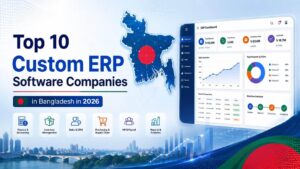
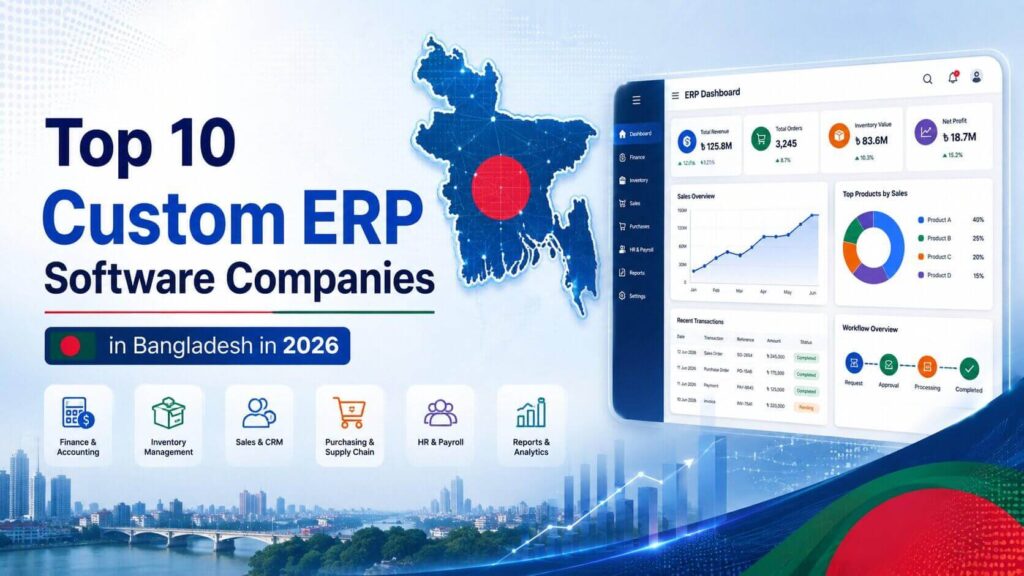
To make the research easier, here are 10 custom ERP software companies in Bangladesh to consider in 2026.
This is not an award or an official ranking. The purpose is to help businesses understand different options before choosing an ERP partner.
1. MM IT SOFT LTD
MM IT SOFT LTD is a custom software development company based in Dhaka, Bangladesh.
The company focuses on developing ERP software around the actual workflow of a business instead of forcing every company to use the same fixed system.
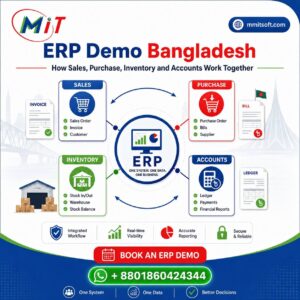
ERP solutions can include sales, purchase, inventory, accounts, HRM, payroll, CRM, POS, manufacturing, project management, branch management, approval systems, and management reports.
This approach can be useful for businesses that have special rules, custom reports, multiple branches, unusual approval processes, or industry-specific operations.
Best for: Businesses that need a highly customized ERP based on their own workflow.
2. Brain Station 23
Brain Station 23 is a well-established software company in Bangladesh with experience in enterprise software, ERP, cloud solutions, and system integration.
It may be a strong option for larger organizations where ERP needs to work with other applications, existing systems, or complex digital platforms.
The company also works across industries such as retail, finance, healthcare, manufacturing, and education.
Best for: Large businesses and complex ERP integration projects.
3. Divine IT Limited
Divine IT Limited is known for its enterprise ERP platform, PrismERP.
Its ERP environment covers important business areas such as finance, sales, supply chain, inventory, human resources, production, and reporting.
This makes Divine IT relevant for organizations that want several departments to work through one connected business system.
Best for: Medium and large businesses that need a broad ERP platform.
4. Pridesys IT Ltd.
Pridesys IT has strong experience in ERP solutions for garments, textile, manufacturing, and other enterprise operations.
This industry focus matters because a factory normally needs much more than sales and accounting.
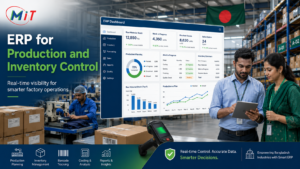
Production planning, raw materials, quality control, employee management, costing, and inventory movement may all need to work together.
Best for: Garments, textile, and manufacturing companies.
5. Logic Software Ltd.
Logic Software is another Bangladesh-based ERP provider with a strong focus on RMG, textile, and manufacturing businesses.
Its ERP solutions are designed around factory and production operations, making it worth considering for businesses where production planning is a major part of daily work.
Best for: RMG, textile, and production-focused businesses.
6. Smart Software Ltd.
Smart Software provides cloud-based ERP and business management solutions.
Its ERP covers common business areas such as inventory, accounting, finance, HR, payroll, procurement, CRM, sales, and production.
Cloud access can also be useful for owners and managers who need to see business information from different locations.
Best for: SMEs, trading businesses, manufacturers, and service companies.
7. Riseup Labs
Riseup Labs works on custom software and enterprise technology solutions.
It can be considered by companies that need more than a standard ERP package, especially when ERP needs to connect with other custom applications or digital systems.
Best for: Businesses needing ERP together with custom software development.
8. AKIJ iBOS
AKIJ iBOS provides Managerium, an integrated ERP platform for managing different parts of a business from one system.
Its ERP environment covers procurement, inventory, warehouse management, sales, accounts, finance, production, payroll, and other operational areas.
It can be useful for businesses with several departments and locations.
Best for: Trading, manufacturing, distribution, retail, and multi-department businesses.
9. Tirzok
Tirzok provides cloud-based ERP and business management solutions in Bangladesh.
Its ERP covers sales, purchase, inventory, accounting, manufacturing, and related business processes.
The company also provides different business software solutions for companies looking to manage operations digitally.
Best for: SMEs looking for cloud-based business management software.
10. Bdtask
Bdtask is a Bangladesh-based software company with a range of business software products and custom development services.
Its ERP-related solutions focus on areas such as sales, inventory, purchases, suppliers, returns, and reporting.
It can be considered by businesses looking for sales- and inventory-focused business automation.
Best for: SMEs and businesses with sales, purchase, and inventory requirements.
So, Which custom ERP software companies in Bangladesh Is Right for Your Business?
This is where the story becomes more important than the list.
Suppose your customer orders 100 pieces of a product, but your warehouse currently has only 70 pieces.
Ask the ERP company to show you what happens next.
Can the software:
- deliver 70 pieces now?
- keep 30 pieces pending?
- update stock automatically?
- show the remaining order?
- record a partial customer payment?
- update customer due?
- complete the remaining delivery later?
- show everything correctly in management reports?
If the vendor cannot clearly demonstrate a simple real-life situation like this, a long feature list should not impress you.
A good ERP demo should look like your business, not somebody else’s business.
What Should You Compare Before Choosing an custom ERP software companies in Bangladesh
Start with these six areas.
1. Business Workflow Understanding
The development team should first understand how your sales, purchase, inventory, accounts, HR, and management processes actually work.
2. Customization
Check whether important workflows, reports, approvals, invoices, user permissions, and business rules can be customized.
3. Industry Experience
ERP requirements change by industry.
A manufacturing company and a retail shop should not use exactly the same workflow.
4. Integration
Your ERP may need to connect with an eCommerce website, mobile app, payment gateway, attendance device, SMS service, courier system, or another application.
5. Training and Support
ERP implementation does not end when the software goes live.
Your employees need training, and the business needs reliable support when problems appear.
6. Future Growth
Ask what happens when you add another branch, warehouse, department, or hundreds of new users.
Good ERP software should grow with the business.
Frequently Asked Questions
There is no single ERP company that is best for every business. The right company depends on your industry, budget, business size, required modules, customization needs, and future growth plans. Compare vendors based on how well they understand and demonstrate your actual workflow.
First, document your current business process and the problems you want to solve. Then shortlist several ERP providers and ask each company to demonstrate the same real business scenarios. Compare customization, implementation, training, support, security, reporting, and scalability before deciding.
There is no fixed price for every custom ERP project. Cost normally depends on the number of modules, users, branches, reports, integrations, customization level, deployment method, and support requirements. A small system will normally cost less than a complex ERP covering many departments.
Not always. Ready-made ERP can be a good choice when your business follows standard processes. Custom ERP becomes more useful when you have special workflows, approval rules, reports, branch operations, production processes, pricing rules, or integration requirements that a fixed system cannot handle properly.
The modules depend on the business. Common ERP modules include sales, purchase, inventory, warehouse, accounts, CRM, HRM, payroll, manufacturing, POS, project management, approval management, branch management, and reporting.
You do not need every module on day one. Starting with the modules that solve your biggest problems can make implementation easier.
The timeline depends on project complexity. A smaller ERP with a few modules may be completed faster, while a large system with multiple departments, integrations, custom reports, data migration, and advanced workflows may take several months. A phased implementation is often more practical than trying to launch everything at once.
Yes, a properly planned custom ERP can usually be expanded as the business changes. New modules, reports, branches, approval rules, integrations, and features can be added later. This is why scalability should be discussed before development starts.
Ask the vendor to demonstrate your real workflow, explain data migration, user training, support, backup, security, customization, integration options, future upgrade costs, and how additional modules will be handled. Do not make the decision only from a standard sales demo.