
📖 Table of Contents (Tap to Navigate)
- 1. What Is the Best ERP Software in Bangladesh?
- 2. 7 Features to Look for in ERP Software
- 3. SaaS ERP vs Custom ERP: Which Is Better?
- 4. How Much Does ERP Software Cost in Bangladesh?
- 5. How to Choose the Best ERP Software
- 6. When Should a Business Choose Custom ERP?
- 7. Why Choose MM IT SOFT LTD for Custom ERP?
- 8. ERP Buying Checklist for Bangladesh Businesses
- 9. Frequently Asked Questions
- 10. Final Decision: What ERP Should You Buy?
Choosing the best ERP software in Bangladesh in 2026 is not simply about finding the system with the longest feature list. The right ERP should fit your business processes, budget, industry, users and future growth.
For small and medium businesses in Dhaka and across Bangladesh, a modern ERP can connect accounting, inventory, sales, purchasing, HR, payroll, CRM and reporting in one system. But the best choice depends on what your business actually needs.
This guide explains what to compare before buying ERP software, how SaaS and custom ERP differ, what affects ERP pricing in Bangladesh, and how to choose a system that can grow with your business.
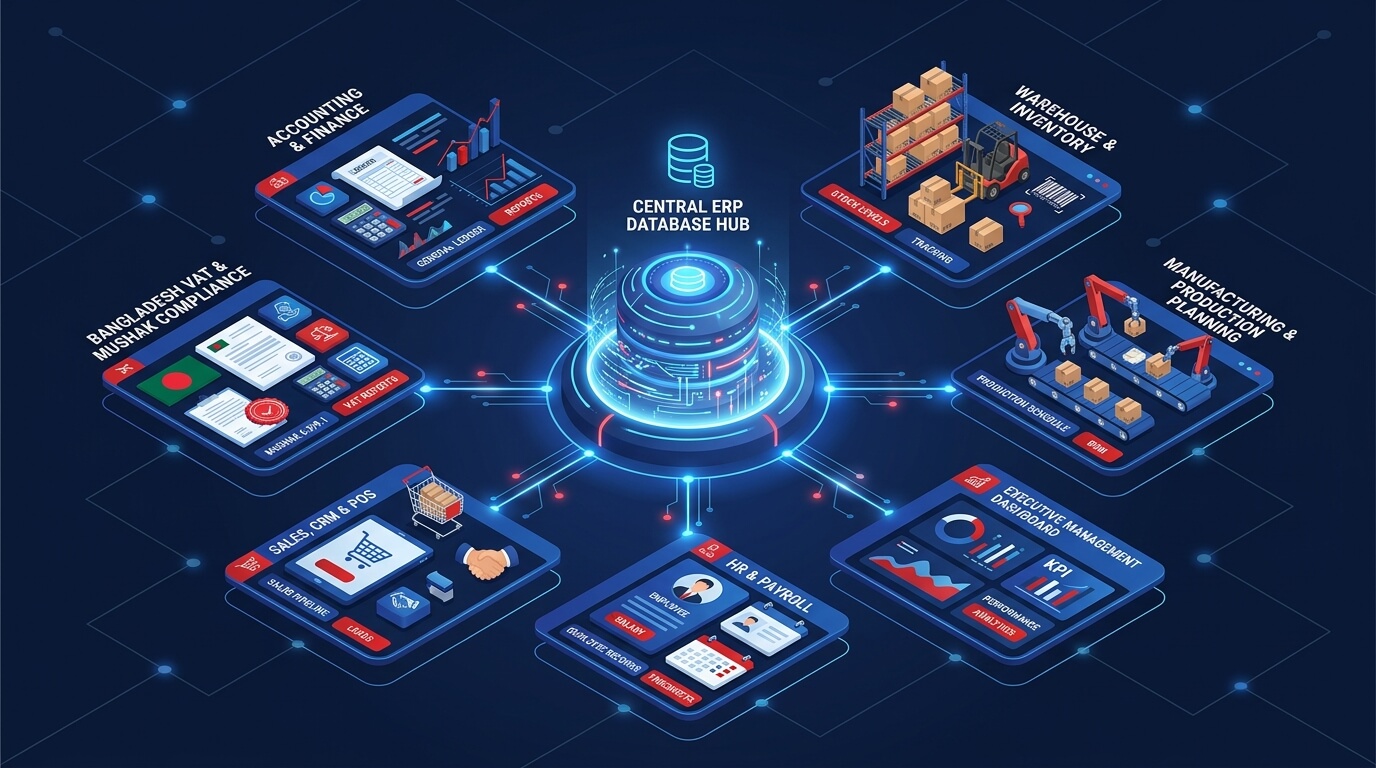
What Is the Best ERP Software in Bangladesh?
The best ERP software in Bangladesh is the system that matches your business workflow, required modules, budget and growth requirements. There is no single ERP that is automatically best for every company.
A trading company may prioritize purchasing, inventory and sales. A manufacturing company may require production planning, raw-material management and costing. A retail business may need POS, warehouse and branch management.
The goal should be to find software that solves operational problems rather than simply buying the software with the most features.
7 Features to Look for in ERP Software in Bangladesh
Accounting and Financial Management
Accounting should be connected to the rest of the business rather than maintained as a completely separate system.
A capable ERP should help manage:
- Sales invoices
- Purchase transactions
- Customer receivables
- Supplier payables
- Expenses
- Cash and bank transactions
- General ledger
- Financial reports
- Profit and loss reporting
- VAT-related workflows where applicable
When sales, purchasing and inventory transactions are connected with accounts, management can get a clearer picture of business performance.
Inventory and Warehouse Management
Inventory management is a critical ERP requirement for businesses that buy, store and sell physical products.
Look for functions such as:
- Product management
- Stock-in and stock-out
- Warehouse management
- Stock transfers
- Purchase returns
- Sales returns
- Stock adjustments
- Low-stock monitoring
- Barcode support
- Branch-wise inventory
- Inventory reports
The important point is integration. A purchase should update inventory, a sale should reduce stock, and relevant financial records should update without unnecessary duplicate data entry.
Sales, POS and CRM
Sales functionality should cover the complete transaction process.
Depending on your business, useful capabilities include:
- Leads
- Customers
- Quotations
- Sales orders
- Invoices
- Sales returns
- Customer dues
- POS
- Sales targets
- Sales reports
- Customer follow-up
For a multi-branch business, branch-level sales and inventory visibility can become especially important.
HR and Payroll
Growing companies also need an organized way to manage employees and payroll.
An ERP may include:
- Employee records
- Attendance
- Leave management
- Salary structures
- Allowances
- Deductions
- Payroll processing
- Employee reports
- Department management
For businesses with a large workforce, also check whether the system can handle attendance data, overtime, leave rules and different salary structures.
Manufacturing and Production Management
Manufacturing companies normally require more than standard accounting and inventory software.
Depending on the factory, useful ERP capabilities may include:
- Bill of Materials
- Production planning
- Work orders
- Raw-material management
- Finished-goods management
- Production costing
- Wastage tracking
- Quality control
- Production reports
- Machine and labour-related records
This is one area where choosing software based only on a generic feature checklist can create problems. Manufacturing workflows often differ significantly from trading or retail operations.
Reporting and Management Dashboard
An ERP should make business information easier to understand.
Management dashboards can bring together information such as:
- Daily sales
- Purchase volume
- Inventory position
- Customer dues
- Supplier liabilities
- Expenses
- Profit
- Employee information
- Production
- Branch performance
Instead of waiting for different departments to prepare separate spreadsheets, management can work from centralized business data.
Bangladesh-Specific Requirements and Integrations
ERP buyers in Bangladesh should also evaluate localization.
Depending on the business, ask vendors about:
- VAT and Mushak-related workflows
- Local accounting requirements
- Payment integrations
- SMS integration
- Courier integration
- E-commerce integration
- Banking/payment workflows
- API availability
- Local customer support
A system that technically works but cannot support your actual local business processes may require expensive workarounds later.
SaaS ERP vs Custom ERP: Which Is Better?
Both SaaS ERP and custom ERP can be effective. The right choice depends on how standardized your business processes are.
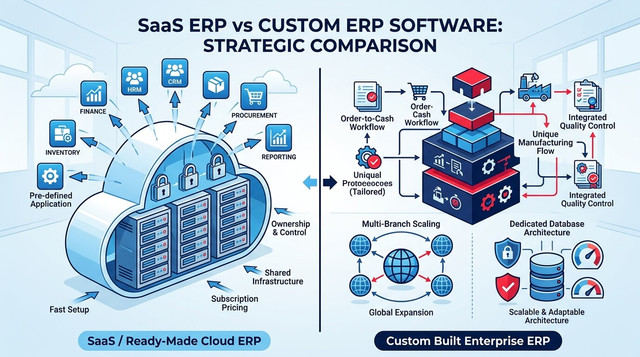
| Factor | SaaS / Ready-Made ERP | Custom ERP (Tailored) |
|---|---|---|
| Initial implementation | Usually faster | Requires requirement analysis |
| Pricing model | Often subscription-based | Usually project-based |
| Standard features | Strong | Can be selected around requirements |
| Custom workflow | Depends on platform | Can be built specifically |
| Industry-specific processes | May require configuration | Can be developed around workflow |
| Updates | Usually vendor-managed | Depends on development arrangement |
| Best suited for | Standard operations | Unique or complex operations |
SaaS ERP can be a practical option when your company:
- Has relatively standard workflows
- Wants faster deployment
- Prefers subscription pricing
- Does not require extensive customization
- Wants vendor-managed infrastructure
Custom ERP becomes more attractive when your business needs:
- Unique approval workflows
- Multiple branches
- Complex warehouse processes
- Industry-specific reports
- Specialized manufacturing workflows
- Custom dashboards
- Existing software integrations
- Custom customer or supplier processes
- Specialized business rules
The decision should therefore be based on workflow fit, not simply whether one option is cheaper at the beginning.
How Much Does ERP Software Cost in Bangladesh?
There is no single ERP price in Bangladesh because ERP projects differ significantly in scope.
The total cost can depend on:
For that reason, businesses comparing ERP software price in Bangladesh should compare the total cost of ownership rather than only the advertised starting price.
Ask every vendor for a clear breakdown of:
This gives you a more realistic comparison.
How to Choose the Best ERP Software for Your Business
Use this process before making a purchase decision.
Identify Your Business Problems
Start with problems rather than software features.
For example:
- Stock information is inaccurate
- Sales and accounts are disconnected
- Employees maintain multiple spreadsheets
- Management cannot see real-time sales
- Customer dues are difficult to track
- Branch performance is unclear
These problems should become your ERP requirements.
Define Required Modules
Separate your requirements into three groups:
Features required for daily operations.
Features that significantly improve efficiency.
Features you may need as the company grows.
This prevents you from purchasing unnecessary functionality.
Test Real Business Workflows
Don't rely entirely on a generic product demonstration.
Ask the vendor to demonstrate an actual workflow.
For example:
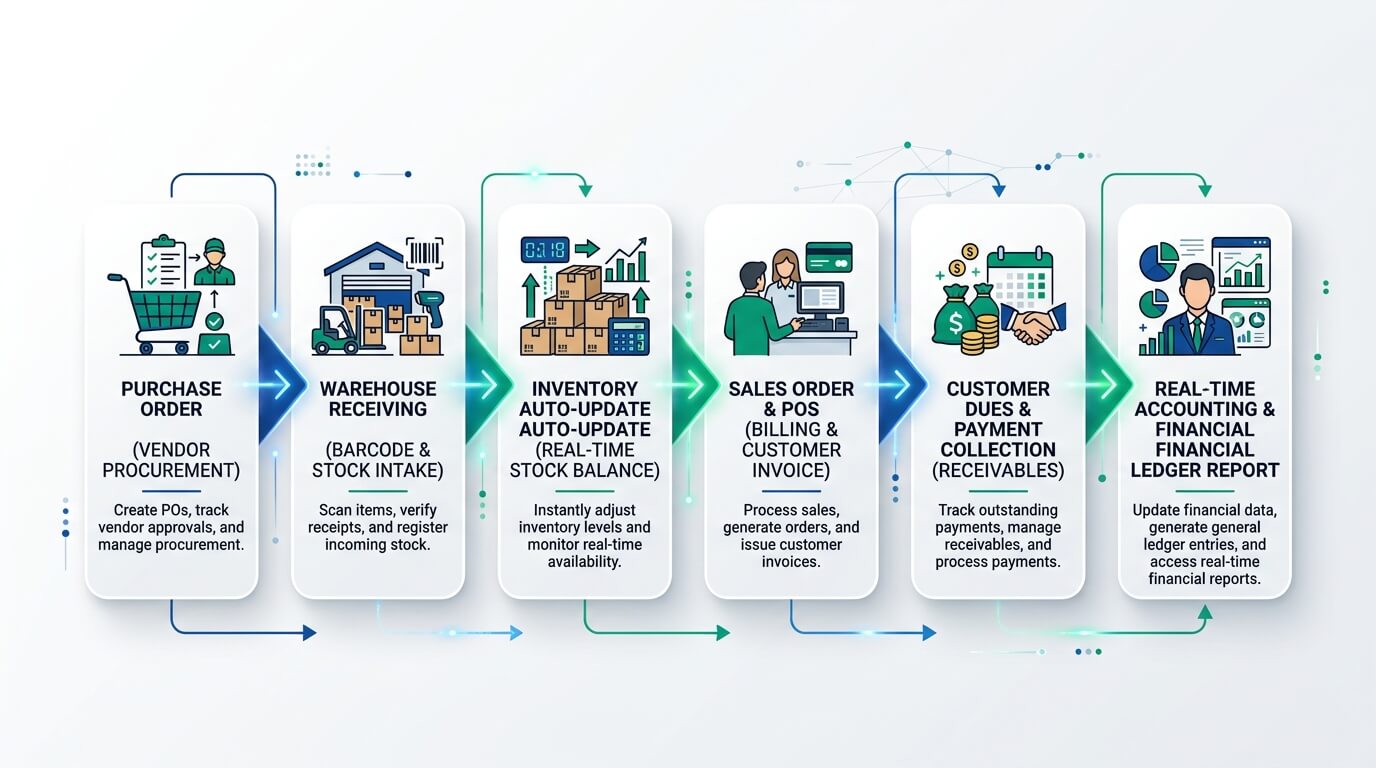
If the vendor can demonstrate the complete process clearly, you have a better basis for evaluating the system.
Check Integration and Customization
Ask whether the ERP can integrate with your existing systems.
Potential integrations include:
- Website
- E-commerce
- POS
- Payment gateway
- Courier
- Accounting
- HR systems
- SMS
- External APIs
Also ask what happens when your business requires a workflow that isn't available by default.
Evaluate Support and Implementation
ERP implementation doesn't end when the software is installed.
Ask about:
- Data migration
- Employee training
- User onboarding
- Technical support
- Bug fixing
- Software updates
- Backup
- Security
- Future customization
The vendor's implementation process can have a major effect on how quickly employees adopt the system.
When Should a Business Choose Custom ERP Software?
Custom ERP is worth considering when standard software forces your business to change important processes or rely on repeated manual work.
For example, a company may need a custom system because it operates multiple branches with different approval levels, manages specialized inventory rules, uses a unique manufacturing workflow or requires reports that standard ERP software cannot provide.
A custom system can be designed around those requirements instead of asking employees to work around the software.
MM IT SOFT LTD provides custom ERP software development for businesses that require business-specific workflows, modules, integrations and reporting.
Why Choose MM IT SOFT LTD is the best ERP software Bangladesh 2026?
MM IT SOFT LTD is a Dhaka-based software company focused on business software and custom ERP development.
Its ERP solutions can bring areas such as:
into a connected business system.
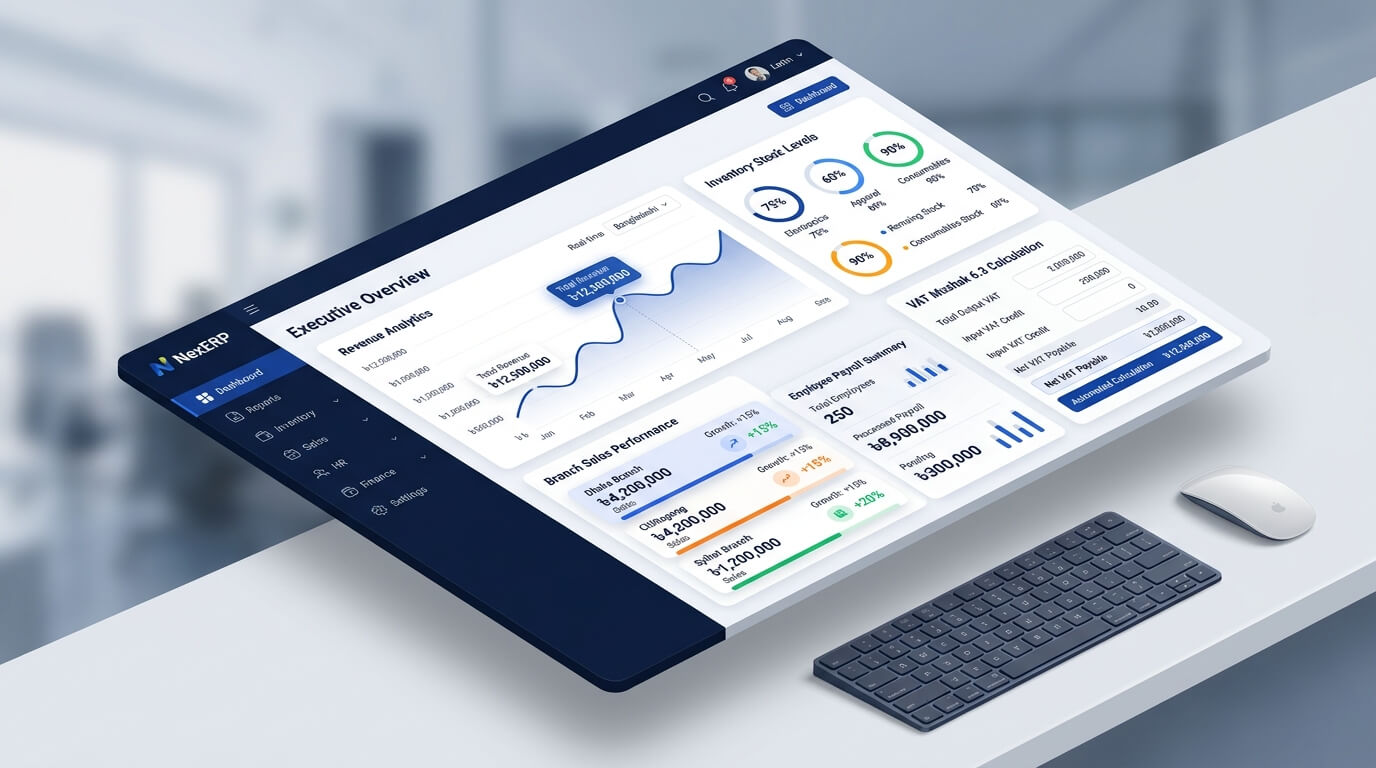
The key advantage of custom ERP is the ability to build the system around the organization's actual workflow.
For a small or growing business, that can mean starting with the most important modules and expanding the system as operational requirements increase.
Before requesting a proposal, prepare your ERP requirements, including your business type, number of users, branches, departments, current software, required reports and major operational problems.
ERP Buying Checklist for Bangladesh Businesses
Before signing an ERP agreement, confirm you have answers to these 14 questions:
Frequently Asked Questions
There is no universal best ERP for every business. The right ERP depends on business size, industry, required modules, workflow complexity, budget, customization requirements, integrations and support.
A SaaS ERP can be suitable for a small business with standard processes because it can provide essential features without extensive implementation. A custom ERP may be more suitable when the business has specialized workflows.
ERP cost depends on modules, users, branches, customization, integrations, implementation, hosting and support. A basic SaaS subscription can cost less initially, while a customized ERP project requires requirement-based pricing.
Neither is automatically better. SaaS ERP is generally suitable for standardized business processes and faster deployment, while custom ERP is better when a company requires specialized workflows or significant customization.
Yes. An integrated ERP can connect purchasing, sales, inventory, customer transactions and accounting so that related information can flow through the same system.
Yes. Custom ERP can be developed around specific workflows, approval systems, reports, branches, warehouses, manufacturing requirements and third-party integrations.
Usually, yes. Excel can be useful for simple records, but growing businesses often need centralized data, user permissions, automated workflows, transaction history, integrated modules and management reporting.
Final Decision: What ERP Should You Buy?
The best ERP software in Bangladesh isn't necessarily the cheapest system or the one with the largest feature list.
Choose the system that gives your business the right combination of functionality, workflow fit, usability, scalability, integration, support and total cost.
For standard business processes, SaaS ERP may provide a faster and simpler route. For businesses with specialized workflows, multiple departments, complex operations or unique reporting requirements, custom ERP can provide greater flexibility.
The smartest first step is to document your current workflow and requirements before comparing vendors. Once those requirements are clear, you can evaluate whether a ready-made SaaS ERP or a custom ERP system is the better investment for your business.